
21 Top Things to Do in Sarajevo for Curious Travellers

Sarajevo is a city that many people remember being a hub of war and terror. The Bosnian War of the 90s hit Sarajevo hard, and while the series of vile atrocities must never be forgotten, it’s also not all that this city should be known for.
Sarajevo is a city of history and culture and food. It is surrounded by green hills and mighty Mount Trebević while the beautiful Miljacka river runs through. Cobbled streets are lined with market stalls selling copperware, vendors selling dark rich Bosnian coffee and sticky nutty baklava. It’s lively; people are friendly and chatty and welcoming. And there is a slow pace to life; no rushing, just enjoying the moment.
Sarajevo is somewhere we will keep returning to (we’ve visited three times so far for a week each time!), so here are our top things to do in Sarajevo for curious travellers.
Disclaimer: This blog post may contain affiliate links, which means that if you click and purchase through a link, we may earn a small commission at no extra cost to you. And if you do choose to do this, THANK YOU so much for supporting us! It means that we can continue to create content for you guys. Full disclaimer here.
1. Baščaršija
This should really be your introduction to the capital, and while it is the prettiest part of the city, it is also the busiest and most touristy. Sarajevo’s bazaar is one of the oldest parts of the city dating back to the 15th century under Ottoman rule.
This main centre very much has all the classic characteristics of an Ottoman market place, from the cobbles to the buildings to the mosque, and it is beautiful and has been well-maintained to keep its historic charm. You could easily spend hours wandering around all the stalls, getting lost in the winding alleyways, shopping for souvenirs. Oh yeah, and I hope you like pigeons because they are EVERYWHERE.


2. Sebilj
This traditional Ottoman water fountain sits in the centre of the main square. It is large and wooden and intricately decorated with a dome on top. Local legend says that if you drink from the fountain, you will return to Sarajevo someday. Now I’m not superstitious or anything but we did drink from that fountain and have been back three times now, so…

3. Kazandžiluk (Copper Street)
The oldest street in Sarajevo, Kazandžiluk exclusively has shops selling copper and metalware, everything from magnets, to coffee pots to mortar shells repurposed into vases. Wander through, step inside and check out the latest designs that the coppersmiths are hammering.

4. Take the Cable Car up Trebević Mountain
You can actually hike up Trebević mountain, and from what I’ve been told it’ll take about two hours, or you can take the cable car. It’s pretty modern and the views are amazing, but tickets are not cheap. Expect to pay 30 BAM for a return journey of 20 BAM for a single. We would recommend getting the cable car up the mountain and then walking down via the famous abandoned Olympic bobsled track.

5. Walk the Abandoned Olympic Bobsled Track
One of the most unique things that you can do in Sarajevo! Back in 1984, Sarajevo hosted the winter Olympics as a neutral Yugoslav party where people from both sides of the Cold War came together to compete. And one of the major winter events is the bobsled, the track for which runs down the side of Trebević.
Today the track is still there, though very much abandoned and not in use (for bobsled anyway). The track has become a canvas for street artists and graffiti artists and it’s impressive. Walk down the track, imagine what it was like back then, and take some unique and interesting photos.

6. Learn about Sarajevo’s History
Even if you come to Sarajevo for a short time, learning about what happened during the war is an absolute must. There are many museums around the city focuses on different elements of Sarajevo’s and Bosnia & Herzegovina’s history. We’ve been to six of them, so I’ve got a full blog post on the best ones to visit coming soon!

Savvy Traveller Pro Tips 🇧🇦
After exploring Bosnia and Herzegovina for two months, these are our favourite booking tools that we couldn’t travel without!
7. The Latin Bridge and the Trigger Point of WW1
Now, the Latin Bridge is pretty and all. Like, you can get some great photos of its arch over the river with buildings in the background. But, the main reason why this bridge is famous is because it is recognised as the place of the trigger point for WW1. Back in 1914, when Bosnia and Herzegovina was under Austro-Hungarian rule, Franz Ferdinand (yep, the rock band has the same name as the ex-archduke of Austria) visited Sarajevo.
Gavrilo Princip, who was a young Bosnian Serb nationalist with a terminal illness, shot both the archduke and his wife as they drove past the bridge in an open-top car. Austria-Hungary declared war on Serbia, some European countries declared alliance with Austria-Hungary, while others stood on side with Serbia, and World War One began.
And even though the bridge has kind of got stuck with the name of the spot where WW1 started, it was actually just beside the bridge on the other side of the road. The actual spot where Gavrilo Princip stood to take his shot is actually marked with footprints and a plaque.

8. Gazi Huzrev-beg Mosque
This is a beautiful historic mosque with a large courtyard, and while we have only seen it from the outside, there are specific hours when tourists can enter.
Outside of these hours, you can still wander the courtyard and take photos. And this is actually the spot I recommend you be for the best view for our next spot.
9. ‘Ala Turca Time’ Clock
From the courtyard of the mosque, you can see and ancient and very unusual clock tower. The clockface itself doesn’t have numbers to tell the time because it uses a completely different method of counting. This is believed to be the one and only example of this unique clock that uses ‘ala turca time’, which actually measures the time of the sun being visible. During Ramadan, this clock becomes very useful!

10. Inat Kuca (Spite House)
This is a cute traditional building sat right on the river, which nowadays serves up local Bosnian food for a slightly hefty price tag. But back in the days of Austro-Hungarian rule, this house was actually on the other side of the river where the city hall is today.
The owner of the house and the surrounding houses were asked to leave to allow for the mighty city hall to be built in this strategic position, and though everyone else agreed and accepted payment, one owner did not. After much debate and wildly high offers of compensation, the owner agreed to move out only under the condition that his house be rebuilt brick by brick from one side of the river to the other. And that is how Inat Kuca was moved across the river; hence Spite House.

11. Vijećnica (City Hall)
The grand city hall that was built in the place of Inat Kuca is pretty spectacular and wouldn’t look out of place in a city in North Africa. The building is large and colourful and has intricate detailing. But it didn’t always look like this. It used to have a huge library which was targeted by the Serb Army during the Bosnian War, and has since been rebuilt in a similar fashion.

12. Tašlihan (Caravanserai Ruins)
As a prominent spot on the ancient Silk Road, Sarajevo had several hans and caravanserais for merchants to rest and stay for the night. There is only one that has been maintained and restored (Morića Han), but you can see the ruins of Tašlihan. They have been cordoned off and a boardwalk placed over the top so you can take a wander.

13. Gazi Huzrev-beg Bezistan
Right beside the ruins of Tašlihan is an old bezistan (covered marketplace). It’s a historic building that now houses very modern glitzy shops selling jewellery and souvenirs. Not an essential visit but interesting to walk through a little bit of history.

14. Stand at the Meeting Point between East and West
Sarajevo centre has its old Ottoman-style section with cobbles and historic buildings, and it very abruptly ends and turns into a more modern cityscape of high street shops and restaurants. There is an actual line that depicts the change in style. One minute you’re in Ottoman Bosnia, and two steps later you’ve jumped forward in time to Austro-Hungarian Bosnia.

15. Go on a Free Walking Tour
There are several companies running free walking tours around Sarajevo, and it has to be a top thing to do here in this city. Learn about the ancient Ottoman history, the Austro-Hungarian period, and the most recent Bosnian War from people who have lived through it themselves. There is so much history in this city that you can’t leave without learning at least a little about it. We went on a free walking tour with Adis and he really knows his stuff!
16. Sacred Heart Cathedral
This Catholic cathedral is huge and prominent standing tall in the centre of the newer part of town. You can see the bullet hole scars from the war in the bricks on the front of the church, and a Sarajevo rose right in the front of the church which just goes to show that even religious places weren’t protected during the siege.

17. Sarajevo Roses
Sarajevo roses are a prominent feature that you’ll see all over Sarajevo. During the war, mortar bombs were heavily used all over the city. The areas where the bombs landed and killed multiple people, has left large scars on the ground, and instead of covering them up or filling them in, they have been painted red and left in plain sight as a reminder.

18. Walk Along the Miljacka River
The section of the Miljacka river nearest the old part of town isn’t the nicest to walk along because its alongside a busy road on either side. However, walk a little further out of town and it’s a really lovely, peaceful spot to wander or even go for a jog. There is a footpath down towards Grbavica which is marked ‘Aleja Lipa’, but either side of the water has a great path to walk along.
This part of town is much less busy, it’s quieter, more relaxed, and much fewer tourists. And if you’re on the side nearest the Canned Beef Monument, go and take a look. It represents the survival food brought in through the tunnel to keep the population of Sarajevo going through the siege.

19. See the Panoramic Views from the Yellow Bastion
From the centre of the old town wander uphill for maybe 15 minutes until you come to the Yellow Bastion. You’ll find a café/bar at the top here and some tables and chairs, but most importantly, amazing views over the city. This is the most popular sunset spot in Sarajevo so it can get pretty busy around this time, however, we have somewhere that we think actually has better views without the crowds.

20. A Better Viewpoint Without the Crowds
So, while everyone stops at the Yellow Bastion for the views, carry on up the road to here. There is nowhere to sit, it’s just at the side of a quiet road, but the views open up and you can see over Sarajevo and Miljacka river.

21. Try a Local Sarajevsko Beer
Sarajevo’s brewery is somewhat of an institution, having been around since 1864, survived the Bosnian War and still brewing to this day. To make beer, you obviously need water, and so when everything was cut off to the city during the siege, the brewery kept pumping the water to give to the local people of Sarajevo. And apparently, they even carried on making a small amount of beer during the siege!
Today, you can find Sarajevsko beer all over the country, or you can visit the brewery itself.

How to Get to Sarajevo
Sarajevo’s airport (SJJ) is well-connected to a lot of Europe and some of the Middle East.
If you’re already on the ground in a neighbouring country, you can take buses from Podgorica or Kotor in Montenegro to Trebinje in the south of the Bosnia & Herzegovina before transferring to get to Sarajevo. Definitely spend a little time in Trebinje; it’s cute and quaint and peaceful.
If you’re in Dubrovnik, there are direct buses that can get you to Sarajevo in 6 or 7 hours.
If you’re at Plitvice Lakes National Park, you can cross the border to Bihać in Bosnia & Herzegovina (make sure you don’t miss Una National Park too!), and then take a bus south to Sarajevo to get there in about 6 or 7 hours.
If you’re in Zagreb in Croatia or Belgrade and Novi Sad in Serbia, there are buses that will take you straight to Sarajevo.
And within Bosnia & Herzegovina, all roads (and buses) quite literally lead to Sarajevo!
How to Get Around Sarajevo
Sarajevo is a walkable city but sometimes you might need to go further afield. Sarajevo is pretty much in one long line from just outside of Ilidža to Baščaršija. There are trams, trolleybuses and regular buses that operate this route. Jump on board, pay in cash, and you’re away. They’re also easy to navigate because they just go in one long line and back again.

Where to Stay in Sarajevo
Villa Basamak (£)
Villa Basamak has lovely, clean, minimalist rooms that are in a great central location to see all the top sights.
Hotel Aziza (££)
Hotel Aziza has large, bright, modern rooms with beautiful views over the city. Again in a central location perfect for sightseeing.
🛏️ Book Hotel Aziza 🛏️
Where to Eat in Sarajevo
Well, that’s a whole different blog post! Coming SOON!
Where’s Next?
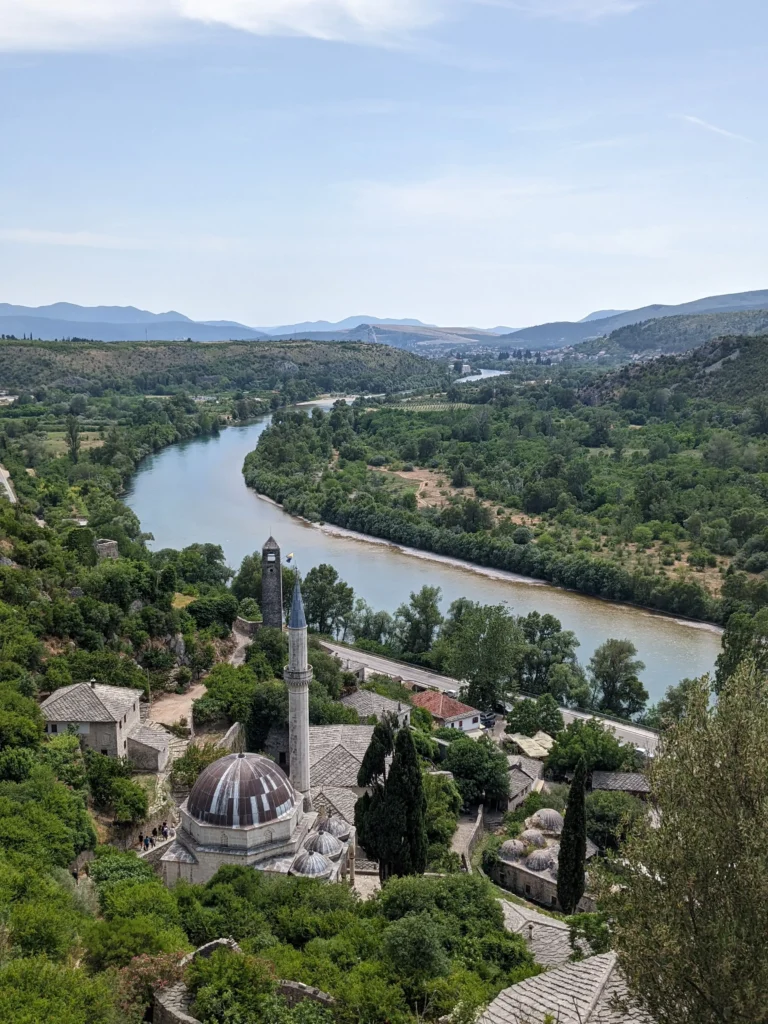
Head to Herzegovina to explore the famous picture perfect Mostar with its iconic bridge, the unique Dervish Blagaj Tekija, or nearby historic and largely abandoned Počitelj, or green and peaceful Trebinje with its vineyards.
Venture north to Bosnia & Herzegovina’s medieval towns of Travnik and Jajce, and further north to beautiful Una National Park for an off-the-beaten-path adventure.

Found this post helpful?
We’d really appreciate your support by buying us a coffee. It’ll help us to keep creating free food & travel guides for your next adventure.
It would make our day! And we really do love a good coffee 😉

Like it? Save it!

